
N-Acetylneuraminic Acid (Sialic acid, Neu5Ac)
| CAS No.: 131-48-6 | Request for quotation |  |
|
|
APPLICATION N-Acetylneuraminic acid is usually called sialic acid or Neu5Ac,naturally widespread carbohydrate with numerous biological functions, including blood protein half-life regulation, variety of toxin neutralization, cellular adhesion and glycoprotein lytic protection. Starting reagent of biochemical derivatives for the synthesis pharmaceuticals. Sialic acid is a derivative of a nine-carbon monosaccharide. Sialic Acid was named from the Greek Sialos for Saliva. It is the negative charge of this ubiquitous chemical that is responsible for the slippery feel of saliva and mucins coating the body’s organs. Despite its role of acting as ‘decoy’ for invading pathogens, sialic acid is increasingly becoming known as an agent necessary for mediating ganglioside distribution and structures in the brain. Work in the 1980’s identified sialic acid supplementation in (suckling) rats to alter behaviour and increase performance in various mazes, suggesting a role in learning and memory. However work in out lab is focussing on the role of virility that sialic acid endow. With the use of adult rat models, we have shown that sialic acid (namely the NeuAc form) acts as an agent to increasing the number of copulations between mating pairs. A transgenic rodent with reduced sexual appetite (kindly donated by the Kitawaga lab, Japan) was used to see whether oral and intraperitoneal doses of sialic acid increased sexual drive. Within one week the number of copulations of this rat model increased to amounts close to that of rats of virility. Numerous other mating pairs have been set up and we are currently waiting for the exciting results. N-acetylneuraminic Acid N-acetylneuraminic acid (sialic acid) is found in a wide variety of substances and tissues in animals and humans, occurring most abundantly in glycoproteins and glycolipids. Sialic acid is widely distributed throughout human tissues and found in several fluids, including serum, cerebrospinal fluid, saliva, urine, amniotic fluid, and mother's milk. In experimental mammals, it is found in high levels in the brain, adrenal glands, and the heart. In humans, concentrations are found in the brain and kidney as well as many other tissues. Absorption Although specific information is not yet known, it is assumed that sialic acid is readily absorbed when ingested. This is based on its appearance in numerous glycoconjugates (a molecule with one or more sugars attached to a protein or lipid) throughout the body and its excretion in the urine. Excretion Sialic acid is rapidly eliminated via the kidneys. In lab animals, at least 98% of ingested sialic acid is found in the urine six hours after ingestion while about 90% appears in the urine within 10 minutes of an IV dose. During lactation, excretion of the sugar is markedly increased. When this data is applied to humans, most of the sugar would be expected to be excreted within 8 hours of ingestion. Therefore, it, or the other sugars, does not accumulate in body tissues. Functions Sialic acid is an immune moderator that affects the flow resistance of mucus which, in turn, repels bacteria, viruses, and other harmful microbes. In several in vitro and animal studies, the saccharide has been shown to inhibit strains of influenza A and B viruses more effectively than any prescription antivirals. In the April 2001 issue of Protein Science, scientists from Australia reported findings that showed sialic acid was an effective antiflu agent. Another study reported in a 1995 issue of Antimicrobial Agents and Chemotherapy, stated that a sialic acid mixture was up to 1000 times more effective in fighting influenza than potent antiviral drugs. Such viruses can also cause cold sores, hepatitis, viral pneumonia, as well as the common cold. Therefore, this helpful information is nothing to sneeze at!! Safety There does not appear to be any data that indicates any adverse reactions to a supplementation of sialic acid. On the contrary, researchers who, consistantly used high doses in experimental animals, found that the learning abilities of these animals increased. Nor did it seem to matter whether the dose was given orally or intravenously, the result was the same, indicating that the sugar is just as reactive using either route. It is suggested that the maximum safe dosage would be 140 mg. for a healthy 150-pound adult. Dietary Sources Whey protein isolate or concentrate ?not the powder (even those allergic to dairy products are able to tolerate this substance. It appears that the concentrate has a higher amount of sialic acid than the isolate.) |
|||
N-Acetylneuraminic Acid (Sialic acid, Neu5Ac) Specification
| Appearance | White to off-white powder | Standard Packing | 1kgs/bag or per customer request | |
| Assay (HPLC) | ≥ 99% | Inventory | Normally we have N-Acetylneuraminic Acid (Sialic acid, Neu5Ac) in stock | |
| Loss on drying | ≤ 1.0% | |||
| Lead | ≤ 10 ppm | N-Acetylneuraminic Acid (Sialic acid, Neu5Ac) physical parameters | ||
| Solubility | 50 mg/ml, clear colorless solution | CAS No: | 131-48-6 | |
| Residue on Ignition | ≤ 0.1% | Formula | C11H19NO9 | |
| Molecular Weight | 309.27 | |||
| Synonym | 5-Acetamido-3,5-dideoxy-D-glycero-D-galactononulosonic acid, Lactaminic acid, NAN, NANA, Sialic acid | |||
| Structure | 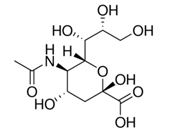 |
|||
| Certificate of Analysis | N-Acetylneuraminic Acid COA | |||
| Literature | N-Acetylneuraminic Acid literature | |||
| MSDS | N-Acetylneuraminic Acid MSDS | |||
| References: | ||||
| 1. | ||||
| 2. | ||||
| 3. | ||||
|
Copyright © 2020 - . All Rights Reserved. |
||||
|
Home >>
|
Product >>
|
Carbohydrate >>
|
N-Acetylneuraminic Acid (Sialic acid, Neu5Ac)
|