Tiagabine hydrochloride
| CAS No.: 145821-59-6 | We also offer S-Isomer and Racemic Tiagabine for analysis purpose, our min order is 50mg, for price, please contact us directly. | Request for quotation |  |
|
About Tiagabine Hcl What is the most important information I should know about tiagabine? What is tiagabine? What should I discuss with my healthcare provider before taking tiagabine? How should I take tiagabine? What happens if I miss a dose? What happens if I overdose? What should I avoid while taking tiagabine? What are the possible side effects of tiagabine? What other drugs will affect tiagabine? Attation: Our tiagabine (Gabitril) can not used in human directly. Our tiagabine can be use in research purpose and pharmaceutical line. Technology discussion: How to Separate the S(+) and R(-)-enantiomers of tiagabine.HCl and its two chiral precursors by chiral chromatography: application to chiral inversion studies. Following is the detail. Chiral HPLC methods were developed and validated for tiagabine.HCl and its two chiral precursors to determine the chiral purity of the three compounds to ensure the quality of the final product which is used as a new antiepileptic drug. Tiagabine.HCl was derivatized with 1-napthalenemethylamine and was chromatographed on a Pirkle type phenyl glycine column with a mobile phase of 69:31, 0.1 M ammonium acetateacetonitrile (v/v). The two chiral precursors were chromatographed on a Chiralcel-OG column with a mobile phase of hexane, isopropanol etc. Each of the three HPLC methods have a selectivity factor (@a) of 1-2 or higher. The validation of the methods was done by conducting standard addition and recovery studies of the S(+)-enantiomers in the samples. The %RSD of all three methods were <5 with a limit of quantification of 0.05% (peak area) or lower. By using these methods, a study was conducted to investigate the effect of pH, temperature, and trace levels of transition metals such as Fe^3^+, Co^2^+, and Ni^2^+ on the conversion of R(-)-enantiomer to the S(+)-enantiomer of tiagabine.HCl and its two chiral precursors. The results of this study demonstrated that the two chiral precursors of tiagabine.HCl under reflux conditions are more sensitive to chiral inversion than tiagabine.HCl. Under reflux conditions, in the presence of trace metal ions and different pH, approximately 10, 11, and 1% of the R(-)-enantiomer was converted to the S(+)-enantiomer for ethyl nipecotate, ethylester of tiagabine, and tiagabine.HCl, respectively. However, at room temperature, tiagabine.HCl appears to be less chirally stable than its two chiral precursors. Approximately 0.4% R(-)-enantiomer of tiagabine.HCl was converted to the S(+)-enantiomer at room temperature and acidic conditions. Under similar conditions, the S(+)-enantiomer of ethyl nipecotate and ethylester of tiagabine.HCl was <0.05%. The initial S(+)-enantiomer content for all three compounds was <0.1%. |
|||
Tiagabine hydrochloride Specification
| Appearance | White to off-white crystalline powder | Standard Packing | 50g/bag or per customer request | |
| Purity (HPLC) | ≥ 98% | Inventory | Normally we have Tiagabine hydrochloride in stock | |
| Optical rotation | [α]D25= -9.80 ~ -10.80 (c=1, H2O) | |||
| Melting point | 190.0 °C - 200.0 °C | Tiagabine hydrochloride physical parameters | ||
| Loss on drying | < 6% | CAS No: | 145821-59-6 | |
| Residue on ignition | < 0.2% | Formula | C20H25NO2S2 ·HCl | |
| Heavy metals | < 2ppm | Molecular Weight | 412.01 | |
| Acetone | < 5000 ppm | Synonym | (3R)-1-[4,4-Bis(3-methyl-2-thienyl)-3-butenyl]-3-piperidinecarboxylic acid hydrochloride | |
| Solubility | Soluble to 50 mM in water and to 100 mM in DMSO | |||
| Structure | 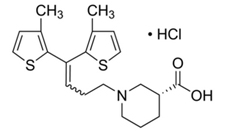 |
|||
| Certificate of Analysis | Tiagabine hydrochloride COA | |||
| Literature | Tiagabine hydrochloride literature | |||
| MSDS | Tiagabine hydrochloride MSDS | |||
| References: | (The papers which used our material) | |||
| 1. | Y. Xu et al: Biochemical and Biophysical Research Communications 361 (2007) 499–504 Homeostatic plasticity of GABAergic synaptic transmission in mice lacking GAT1 Full text | |||
| 2. | Xu et al: Journal of Neuroscience Research 86:465–470 (2008) Hypoalgesia in Mice Lacking GABA Transporter Subtype 1 Full text | |||
| 3. | McDonald et al: Psychopharmacology (2008) 197:591–600 Discriminative stimulus effects of tiagabine and related GABAergic drugs in rats Full text | |||
| 4. | Masuda et al.: Neurobiol Dis. 2008 June ; 30(3): 293–302 Tiagabine is neuroprotective in the N171-82Q and R6/2 mouse models of Huntington's disease Full text | |||
| . | ||||
|
Copyright © 2020 - . All Rights Reserved |
||||